























.jpg)



This year, there was a major debate about whether the American economy would witness the recession or worse.
Those who believe that the economy faces a reckoning point to the growth of domestic GDP, increased job losses, and the effects of trade war on inflation and supply chains. Others refer to the historically low unemployment rate, wages that exceed inflation, and support support as reasons that we will avoid stagnation.
Related: Goldman Sachs reveals the prediction of definitions and recession expectations
It is undoubtedly difficult to predict what will happen to the next economy. However, investors are right to worry about stagnation because sales slowing and profits are great winds for American companies. Given that stock prices track profits over time, the S&P 500 revenues during the recession are suddenly dull, according to Fidelity Investments.
However – there is one silver lining about the recession that investors should remember.
What is the recession and is it possible in 2025?
GDP is a measure of economic activity, and the recession is usually described as two or more consecutive fourths of GDP. However, this is not always the case.
The official declaration of stagnation is carried out by the National Office for Economic Research, and is not always committed to virtue of two quarter of economic deflation.
💸💰Do not miss this step: Subscribe to the free daily newsletter of Thestreeet 💰💸
“They look at a set of indicators to measure it if the United States is in stagnation,” He said Naveen Malwal, Advisers LLC, the money management arm for Fedelity Investments. “For example, they believed that the recession of 2020 occurred from February to April of that year, which was not lined with two entire quarter of GDP.”
Regardless of how Nber defines stagnation, the recession usually occurs when unemployment rises and economic activity decreases.
We already see evidence of this. Although unemployment is historically low at 4.2 %, it still rises from a decrease of 3.4 % in 2023. More importantly, companies announced more than 602,000 layoffs in 2025 to April, the highest year to date since the Covid-19 closed in the United States in 2020, and 87 % more than the previous year.
Total GDP, with a large stagnant mark
GDP numbers in the first quarter are also regarding. Bea’s pre -appreciation of GDP in the first quarter was 0.3 % negative, represented by the first quarter of the GDP since Covid.
However, negative domestic domestic product printing comes with a large assembly mark. Many companies pulled imports forward to avoid customs tariffs, send high imports, and gold activity increased. Eliminate those inputs from the gross domestic product account, and turns the economy to the growth of the first quarter.
Unemployment and gross domestic product are backward indicators on economic health. What about the leading indicators? Well, they send mixed signals.
More economic analysis:
- The Federal Reserve’s inflation scale puts the risk of stagnation as the bite of tariff policies
- American recession jumps with a decrease in gross domestic product
- Like or not, the bond market rules everything
For example, the conference’s expectations index fell to 54.4. Usually, readings of less than 80 indicate that the recession is on the horizon. Also, the ISM manufacturing index remains less than 50 at 48.7, which indicates a shrinkage.
However, the leading economic index of the Conference Council in March was still above water at 100.5, even with a decrease of 1.2 % over the past six months.
As a result, the current estimate of the conference council is that this year the economy will slow down but still grow.
“The Conference Council has reviewed the expectations of GDP growth in the United States from 2025 to 1.6 %, which is somewhat less than the capabilities of the economy,” said Justina Zabenska-Llamonica, Senior Director of the Business Course indicators at the Conference Council.
“The expected slow growth rate reflects the effect of deepening commercial wars, which may lead to high inflation, disruption of the supply chain, the least investment and spending, and the weakest labor market.”
Goldman Sachs currently links recession this year by 40 %.
What happens to the S&P 500 during the recession?
To reformulate Mark Twain, the rhymes of history. While no one can carefully predict what stocks will do, the past can provide evidence.
Bad news? Arrows usually generate bad returns during stagnation. Good news? The declines of the staging stock market can create strong returns once the economy returns to the right track, according to the lines of Videliti.
Related: The legendary fund manager sends a 7 -word message on stocks
Since 1950, FIDELIETY is noticed 11 business courses until 2024. The average recession was 11 months, and the average annual S&P 500 during the recession is only 1 %. This is far from the average annual S&P 500 annual return of about 10 % since 1957, and the current current return of the Treasury Department of 4.3 %.
According to sincerity, defensive stocks tend to perform the best during the recession. The basic materials of consumers, health care, communications and utilities outperform, while technological and financial stocks are the worst performance.
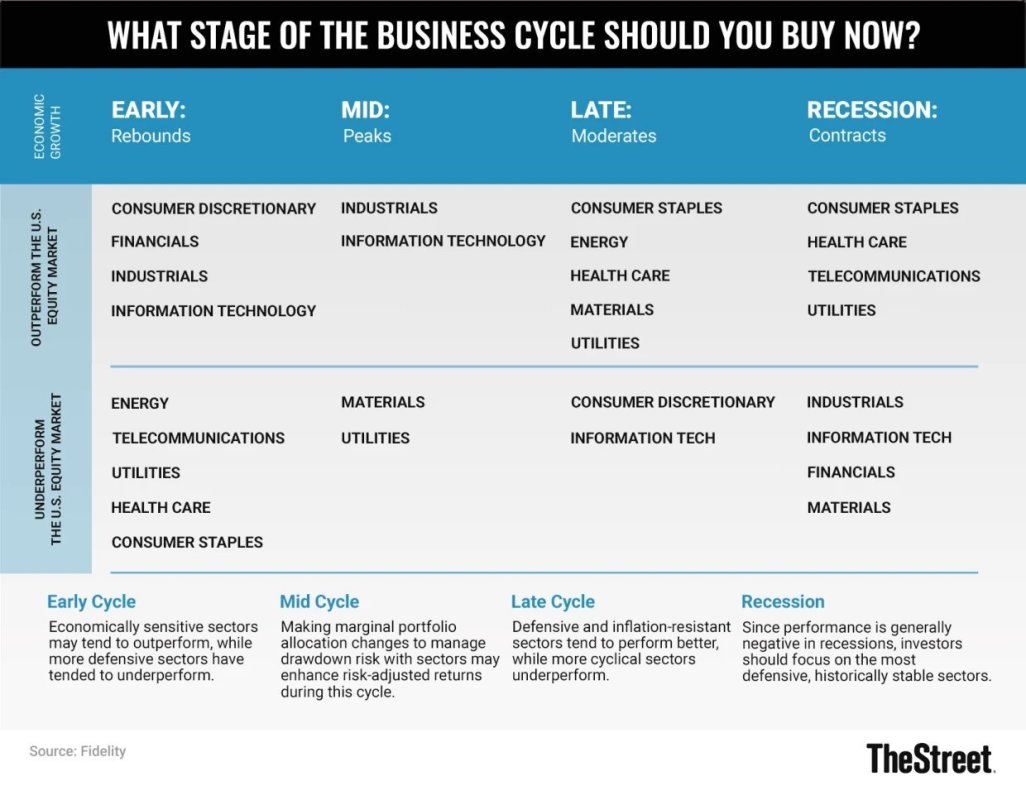
Sincerity and period;
While the unreasonable sectors tend to provide the best recession, investors may not want to change their portfolios significantly.
The stagnation expansion of the recession lasts much longer, and the arrows tend to the bottom before the recession ends, resulting in the best gains in the first year.
Fidelity data shows that the typical expansion period since 1950 lasts 65 months, and that the average annual return during economic expansion represents 15 %.
More importantly, the bottom arrows before the economy do, and no one rings a bell that indicates the lowest level in the stock market. As a result, many who sell for fear of stagnation are slow to buy again, and lose some of the most impressive revenues.
According to CFRA, the average return of the first market market is 38 %. The second year return is only 12 %.
“What we know from history is that the recession comes and goes.” “Historically, when investors come out of the market at a time like this, it is rare to return in time, and this often leads to their loss when things begin to improve.”
Related: The Veteran Fund Director reveals the prediction of the S&P 500
