























.jpg)


It has not been much fun for consumers recently.
It suffers from huge criticism due to high inflation after the supply chain in the unprecedented Covid era and financial and monetary incentives. Families have tightened their belts, and spending turned into the basics.
Restaurant prices have increased, making eating expensive, high interest rate in 2022 and 2023 left mortgage, automatic loans and credit card at high levels of the sky, and disk pockets.
Related: Goldman Sachs reveals the prediction of definitions and recession expectations
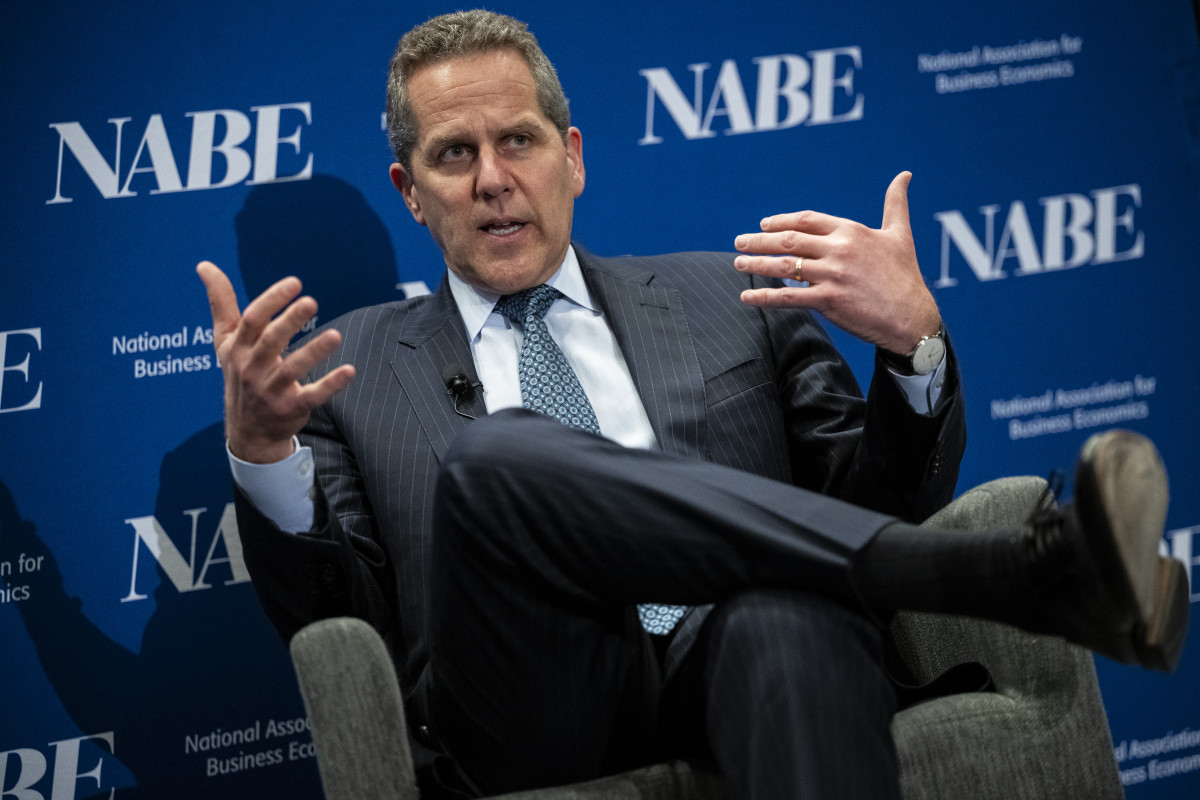
Unfortunately, based on the recent comments of influential federal reserve member Michael Bar, it may get worse for Americans later this year.
Federal reserve is supported in the corner
In 2021, the President of the Federal Reserve, Jerome Powell, said incorrectly that the high inflation would be temporary. It was not. As a result, Powell was forced to change the gears in 2022, where he embraced the most honest monetary policy since the Chairman of the Board of Directors fought Paul Volker fleeing in the early eighties.
It worked high Powell restriction rates, prompting inflation to less than 3 % from 8 % in 2022, but it came at a cost. Increased interest rates hurt consumers and companies, causing them to be compensated, slowing the economy and increasing layoffs.
The unemployment rate is still low but it rose to 4.2 % last month from 3.4 % in 2023. In the second quarter of 2025, about 497,000 Americans have lost their jobs, which is more than that since 2009, according to Challenger, Gray and Christmas legislation.
Function losses at the Federal Reserve last year caused a reduction in interest rates in September, November and December. However, these cuts followed inflation: the consumer price index showed inflation by 2.4 % last month, unchanged from September.
Unemployment and federal sticky inflation supported in a corner, forcing him on the margin, not sure what to do then. Looking at President Donald Trump’s aggressive plans, the decision will not become easier this year.
Trump imposed a 25 % tariff on Canada, Mexico and cars in February. He announced a more mutual tariff than expected on April 2, which was called Liberation Day. Trump stopped most of the mutual definitions on April 9 after the stock market decreased, but it seems committed to the customs tariff scheme.
Currently, China faces 145 % of import taxes, effectively closes trade with America and risks increasing prices on everything from clothes to electronics.
More economic analysis:
- The Federal Reserve’s inflation scale puts the risk of stagnation as the bite of tariff policies
- American recession jumps with a decrease in gross domestic product
- Like or not, the bond market rules everything
Trump said commercial talks with China will start this week, and it has hinted that it may reduce the definitions to 80 % soon. However, regardless of its final number, the definitions may still represent the most important tax increase in 60 years, according to the hedge of the hedge fund Paul Tudor Jones.
Many argue that the definitions will pay for the long term by increasing American manufacturing activity, including jobs. However, most economists say that building a pre -closed American manufacturing capacity will take years, and will not compensate for customs tariffs in inflation in the short term.
The ruler of the Federal Reserve Par
Uncertainty is a big problem for consumers and companies. The absent clarity, families and companies are likely to stop their spending plans, especially if the costs are likely to rise in the wake of the definitions.
Related: Donald Trump’s sudden message sends to the stocks
“The size and scope of the recent increases in the customs tariff is not without a modern precedent.” “We do not know its final form, and it is too early to know how they will affect the economy.”
This uncertainty leaves many educated guesses on how to get rid of things. Bar, who has been traveling in the American economy for decades, is in a better position to extract more conclusions than most of them.
“In my view, high definitions can disrupt global supply chains and create continuous upward pressure on inflation,” said Barr.
Large companies have deep pockets that may allow them to repeat supply chains more quickly than small and medium -sized companies, which may particularly suffer from identification shocks. But the major companies are likely to stop expansion plans, including employment, in order to see the result of any upcoming commercial deals.
“I am very worried that the customs tariff will lead to high unemployment while slowing the economy,” said Barr. “the [Fed] It may be in a difficult situation if we have to see both increased inflation and high unemployment. “
The dual Federal Reserve State is to determine interest rates that balance low inflation and the maximum employment. As we have seen in the past three years, these competing goals could be.
Last month, Federal Reserve Chairman Jerome Powell acknowledged that the difficult situation facing the Federal Open Market Committee in Policy Industry, saying in April, “We may find ourselves in the difficult scenario in which our double goals are in tension.”
Related: The Veteran Fund Director reveals the prediction of the S&P 500
